
From Overwhelm to Ease: Ending 2025 With Nervous System Support

It's the second week of December and you're already counting down to January.
Not because you're excited about the holidays. Because you're exhausted.
The year-end deadlines at work aren't negotiable. The holiday cards need to be sent. The gifts need to be bought. The travel needs to be arranged. Family expects certain things. So do your kids. Your partner. Your boss. Your clients.
And somewhere underneath all of it, there's you. The person who's been running at full capacity since last January.
Who never quite caught their breath after spring turned into summer turned into fall.
Who's now expected to summon joy and presence and holiday magic while operating on fumes.
This is the December paradox: the time of year that's supposed to be about rest, reflection, and connection becomes the most depleting stretch of all.
But here's what most people don't realize. The exhaustion you're feeling isn't just about your schedule.
It's about your nervous system hitting a limit it's been approaching all year.
And pushing through December the way you've pushed through every other month won't get you to January whole. It'll get you there depleted, disconnected, and probably already behind on the resolutions you haven't even made yet.
Why December Hits Different
There's a physiological reason why December feels like too much.
Your nervous system has been managing stress all year. Work demands. Life transitions. Global news cycles. Personal challenges. The constant hum of notifications and information. The pressure to perform, produce, show up, keep going.
For most of the year, your system can handle this through activation. Your sympathetic nervous system kicks in. You get things done. You push through. It works. Until it doesn't.
By December, many people's nervous systems are running on a kind of borrowed energy. You're still functioning, but the regulation capacity isn't there anymore. The buffer that used to help you handle stress is gone. Everything feels harder because it is harder. Your nervous system is doing the same work with far fewer resources.
Then December adds:
• Year-end work intensity (finish strong, meet goals, wrap up projects)
• Holiday preparation (shopping, cooking, decorating, planning)
• Family dynamics (navigating relationships that may be complicated)
• Financial stress (gifts, travel, year-end expenses)
• Social obligations (parties, gatherings, maintaining appearances)
• Pressure to feel a certain way (joyful, grateful, festive)
All while the daylight is shortest.
Your body naturally wants to slow down, rest more, turn inward.
But the world is demanding the opposite.
This isn't about time management or finding balance.
This is about a nervous system that's been pushed to its edge and is finally saying "I cannot keep doing this."
What Happens When You Push Through Anyway
Most of us were taught to just get through December. Power through to the holidays. Make it to January. Then you can rest.
But here's what actually happens when you push a depleted nervous system even harder:
Your body holds more tension.
Shoulders up by your ears. Jaw clenched. Breathing shallow. You might not even notice anymore because it's become your baseline. But your body is bracing against all of it.
Sleep gets worse.
You're exhausted but you can't sleep. Or you sleep but wake up feeling unrested. Your nervous system can't downregulate enough to get the deep restoration you need.
Everything feels harder.
Small annoyances become big frustrations. Tasks that usually take ten minutes feel overwhelming. You have less patience. Less capacity. Less access to the parts of yourself you actually like.
Connection suffers.
You're physically present but not really there. Going through motions. Checking boxes. The presence and meaning you wanted from the holidays feel increasingly out of reach.
Your immune system struggles.
You get the cold that's going around. Or maybe you make it through December and then get sick the first week of January when you finally stop.
January starts from depletion.
Instead of beginning the new year with intention and energy, you start it depleted, disconnected, and needing to recover from how hard you pushed through December.
This is what happens when we treat our nervous systems like they have unlimited capacity. When we ignore the signals that we need support. When we prioritize getting through over being present.
What Your Nervous System Actually Needs Right Now
Not another productivity hack. Not better time management. Not more caffeine or positive affirmations.
Your nervous system needs to downregulate. To release the accumulated tension of the entire year. To remember what settled actually feels like.
This doesn't mean doing nothing or dropping all your responsibilities. It means giving your body what it needs to process stress rather than just accumulating more of it.
Deep rest that's different from sleep.
Sleep is essential, but many people's nervous systems are so activated they can't get truly restorative sleep right now. Practices like Yoga Nidra create a state between waking and sleeping where your body can release tension and reset in ways regular sleep can't when you're this activated.
Somatic practices that discharge stress.
Talk therapy helps process thoughts and emotions. But stress lives in the body. Your nervous system needs movement, breathwork, and body-based practices that actually complete the stress cycle rather than just managing it mentally.
Permission to feel what you're feeling.
The pressure to be joyful and grateful when you're actually exhausted and overwhelmed creates additional nervous system stress. Your body needs to be met where it actually is, not where you think it should be.
Practices that restore regulation capacity.
Not just temporary relief, but tools that help your nervous system remember how to shift from activation to calm, from overwhelm to settled, from survival mode to presence.
Time that's actually restful.
Not productive rest. Not rest with your phone. Not rest that's interrupted every few minutes. Actual, uninterrupted time when your nervous system doesn't have to track anything or respond to anything.
This isn't selfish. It's necessary. Your nervous system can't keep going without restoration. And restoration doesn't happen when you're still pushing.
The Truth About January Intentions
There's so much focus on January as a fresh start. New year, new you. Goal setting. Vision boards. Resolutions.
But here's what most people miss: you can't build anything sustainable from a depleted foundation.
If you push through December and arrive at January exhausted, any goals you set will be coming from depletion rather than desire. From "I should" rather than "I want." From forcing rather than flowing.
The most powerful thing you can do for your 2026 isn't to plan better goals.
It's to end 2025 from a place of regulation rather than depletion.
When your nervous system is resourced, intention-setting looks completely different. You can actually feel what you want, not just think about what you should want. You can sense what your body has capacity for rather than overcommitting from a dysregulated state.
The work you do now, in December, to support your nervous system doesn't just help you get through the holidays. It determines what you're capable of building in the year ahead.


What December Support Actually Looks Like
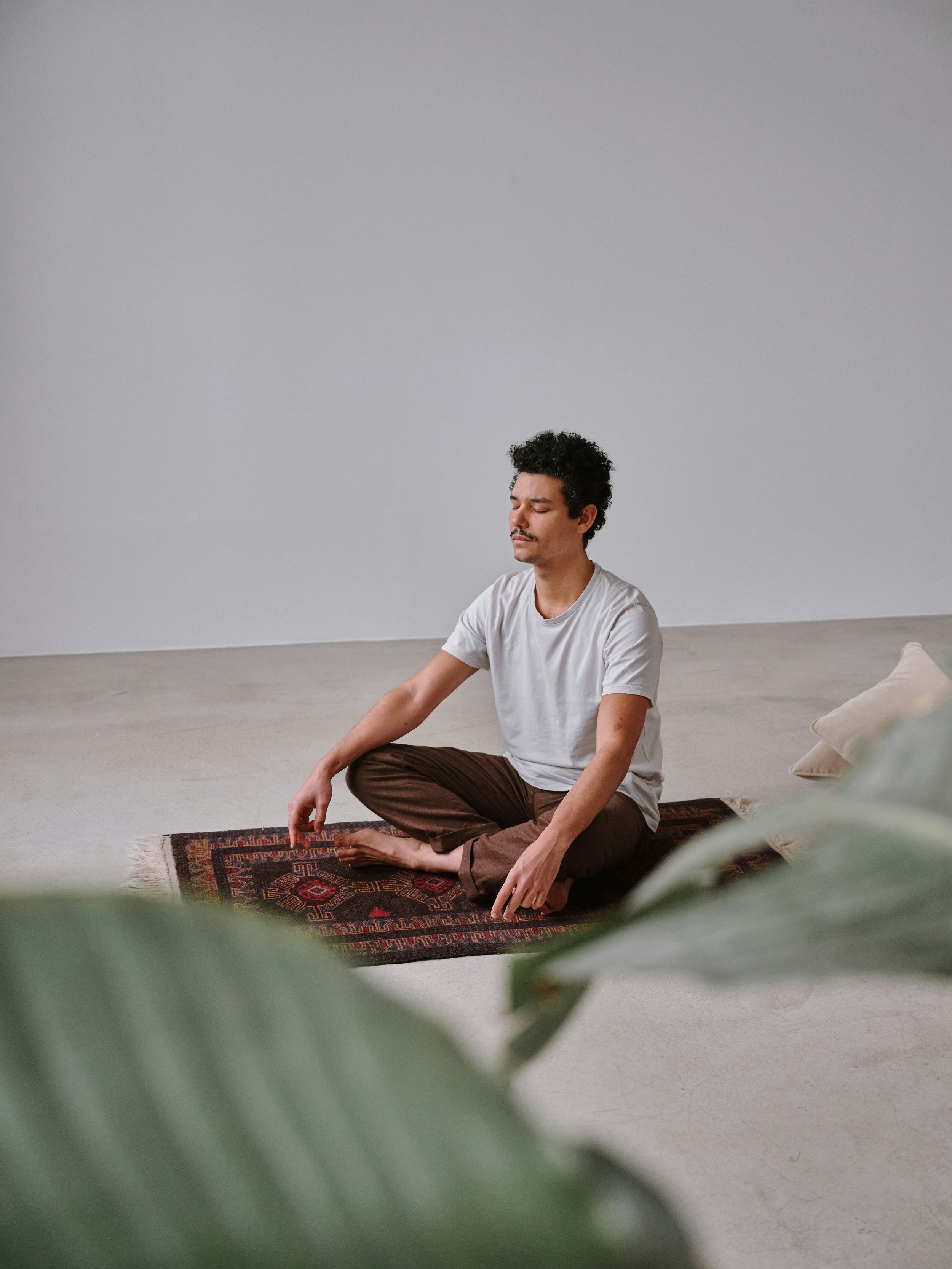
Imagine ending December feeling present rather than depleted. Not perfect. Not stress-free. But resourced enough to actually be there for the moments that matter.
What would need to shift?
Your morning sets the tone.
Instead of immediately jumping into email and to-do lists, what if the first 20 minutes of your day were for your nervous system? Breathwork. Meditation. A practice that helps you come into your body before the demands begin.
You build in actual restoration.
Not scrolling on your phone (which your nervous system reads as more input to process). But 20-30 minutes of guided deep rest where your body can actually downregulate. Where accumulated tension can release.
You notice when you're pushing.
Instead of overriding the signals that you need to slow down, you develop the skill to recognize dysregulation as it's happening. And you have tools to address it in the moment rather than letting it accumulate.
You protect your capacity.
Saying no becomes an act of nervous system care, not selfishness. You get clear about what actually matters and let go of obligations that deplete without nourishing.
You practice ending the day well.
Not just collapsing into exhaustion, but creating a transition that signals to your body that the day is complete. That it can begin to settle. That rest is safe.
This is what nervous system support looks like in real life.
Not adding more to your plate. But approaching what's already there from a regulated rather than depleted state.

21 Days That Change How You End the Year
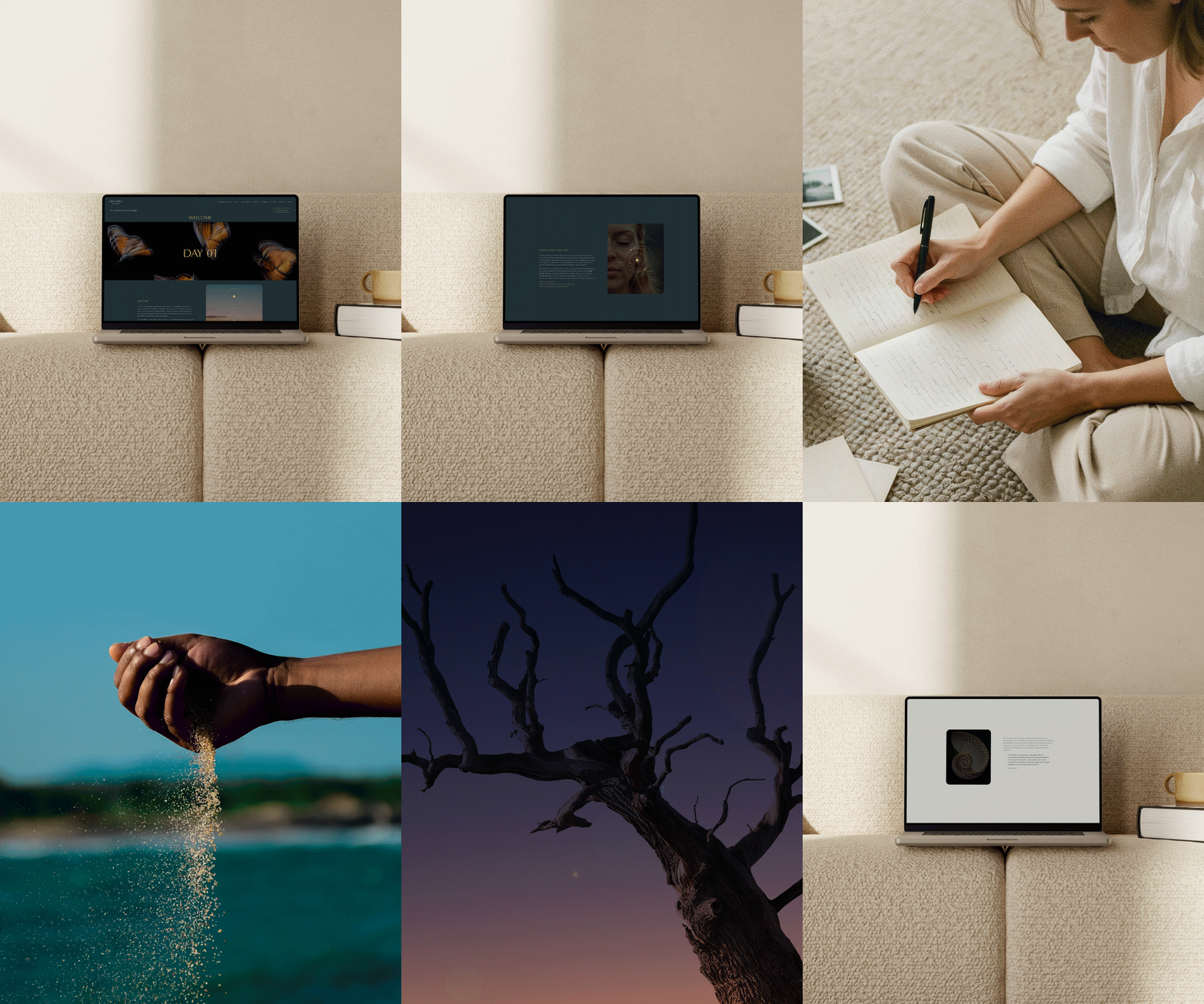
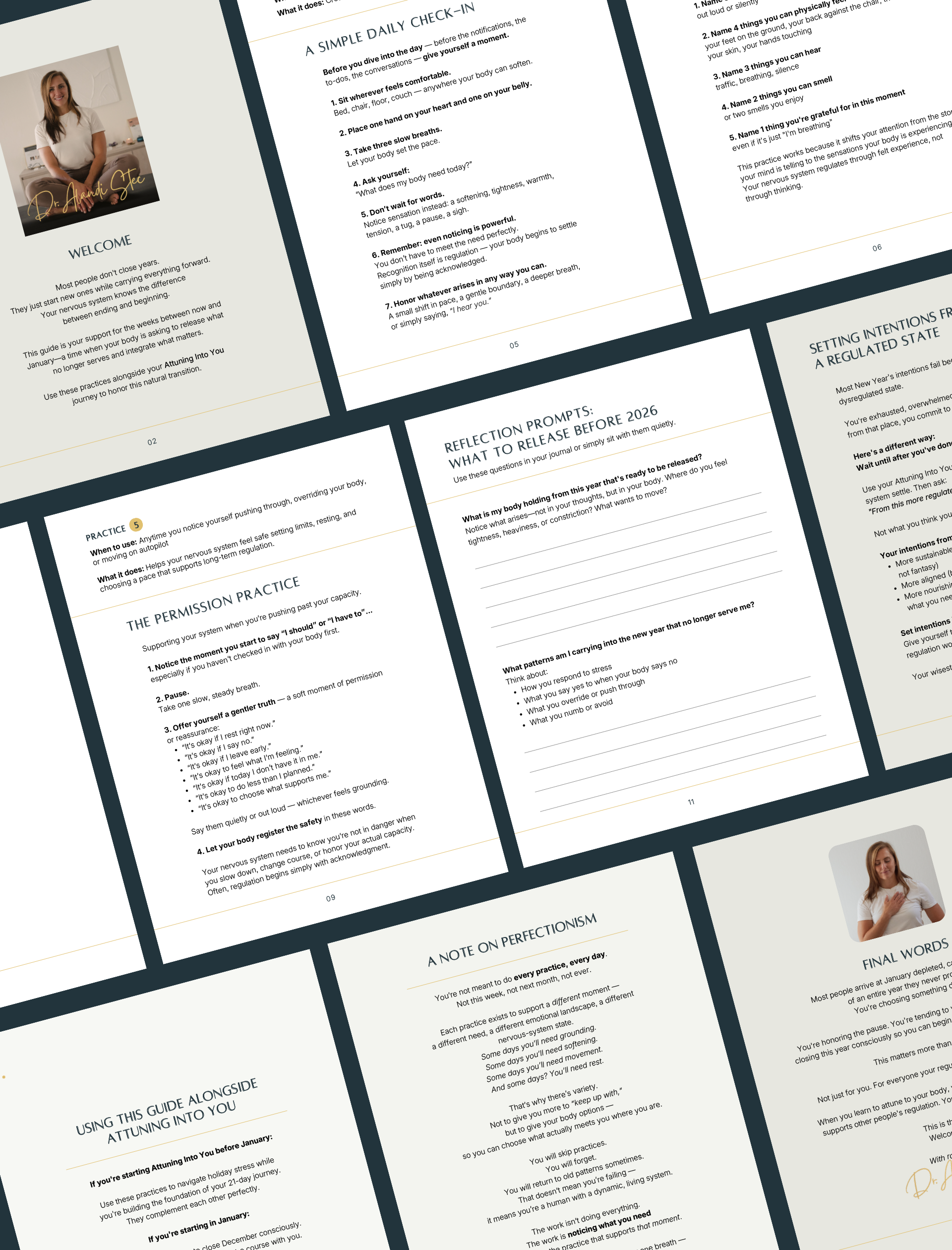
There's a reason the Attuning Into You course runs for 21 days.
Not because change happens magically on day 22. But because your nervous system needs consistent, repeated experiences of regulation to establish new patterns.
One meditation helps. One Yoga Nidra practice creates temporary relief.
But 21 days of daily nervous system care teaches your body what regulation actually feels like. How to shift from activation to calm. How to process rather than accumulate stress.
Three weeks of:
• Guided practices that help your body release what it's been holding
• Breathwork that resets your autonomic nervous system
• Somatic tools you can use when overwhelm hits
• Deep rest that actually restores rather than just temporarily relieves
• Education that helps you understand what your body is experiencing
Starting in December means you're not just getting through the holidays.
You're ending the year with your nervous system supported. You're processing 2025 rather than carrying it into 2026. You're arriving at January from regulation, not depletion.
This is the work that changes everything.
Not because it makes December stress disappear. But because it gives your body what it needs to move through it without breaking.
What Becomes Possible
When your nervous system is supported through December, participants notice:
You're actually present for moments that matter.
Instead of going through motions, you can feel connection with people you love. The holidays become about presence, not performance.
Sleep improves.
Not perfectly, but noticeably. Your body can downregulate enough to get restoration, even when the schedule is full.
Stress feels manageable.
Not because there's less of it, but because your nervous system has capacity to process it rather than just accumulate it.
You end the year complete.
Rather than dragging 2025's unprocessed stress into 2026, you metabolize it. Process it. Release it. So January can actually feel like a beginning.
Intention-setting becomes authentic.
When you arrive at the new year regulated rather than depleted, you can feel what you truly want. Not what you think you should want. What actually aligns with who you're becoming.
Your December Invitation
This doesn't have to be another year where you just survive December and hope January is better.
You can end 2025 with presence. With ease. With your nervous system supported rather than screaming.
The work starts now. Not in January when you're already depleted. Now, when there's still time to shift how you move through the season.
Your body is asking for this. The exhaustion you feel isn't weakness. It's information. It's your nervous system saying "I need support."
Ready to end the year differently?
Attuning Into You is a 21-day journey of nervous system recalibration.
Daily practices that help your body remember how to regulate. Deep rest that actually restores. Somatic tools that work when overwhelm hits.
Start now and finish 2025 from presence, not depletion.
Learn More About Attuning Into You →
About Dr. Alandi Stec
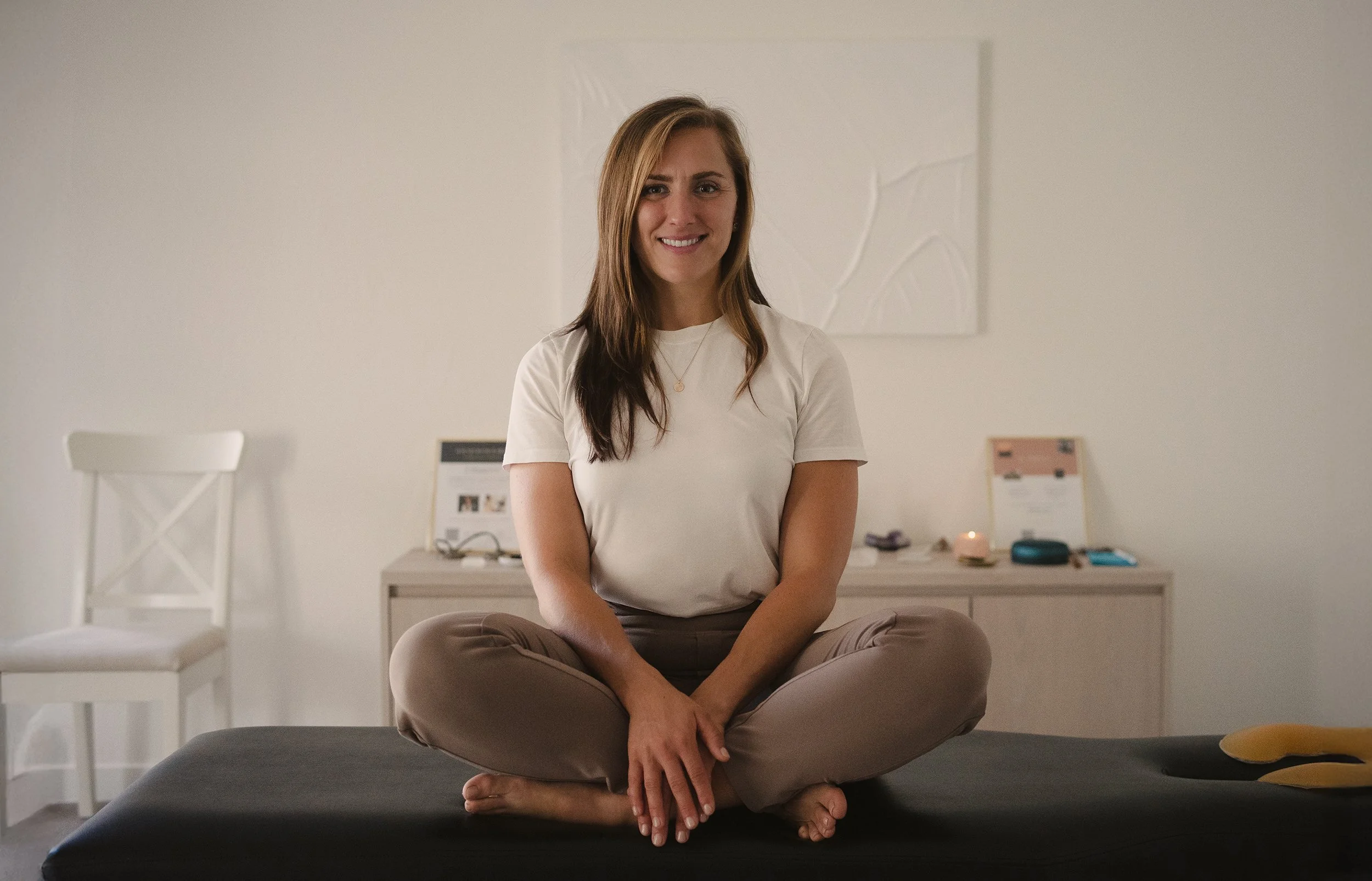
Dr. Alandi Stec is a Doctor of Chiropractic, Reiki Master, and embodied wellness educator specializing in nervous system regulation. Through Attuning Into You and other offerings, she helps people end cycles of chronic stress and build lasting nervous system resilience.