
Release Before Resolve: What Your Body Needs to Do Before January Arrives

You already know what your January intentions will be.
More balance. Better boundaries. Consistent self-care.
Actually following through this time.
Maybe a meditation practice. Definitely better sleep.
Probably something about stress management.
You've made these resolutions before.
Sometimes you keep them for a few weeks. Sometimes they don't make it past the first full week of January.
And when they fall apart, you wonder what's wrong with you.
Why you can't seem to change. Why the motivation fades so quickly. Why you keep starting from the same depleted place year after year.
Here's what no one tells you: the problem isn't your intentions.
It's that you're trying to build change on a foundation that can't support it.
You're attempting to resolve before you've released.
Your body is carrying an entire year's worth of unprocessed stress, accumulated tension, and nervous system activation.
Until you address what you're already holding, anything you try to add on top will eventually collapse under the weight.
This is why January resolutions fail. Not because you're not trying hard enough. But because you're trying to plan from depletion instead of processing toward regulation first.
Why You Can't Plan From Depletion
Think about the last time you made January resolutions from a place of exhaustion and overwhelm.
You probably created a long list of changes. Things you needed to fix, improve, optimize. Habits to start, habits to stop. Ways to finally become the version of yourself you think you should be.
How many of those intentions were rooted in actual desire? How many came from "I should" rather than "I want"? How many were responses to the year you just survived rather than authentic calls toward something new?
When you're depleted, intention-setting looks completely different than when you're regulated.
From depletion, you make plans based on:
• What you think you should want (not what you actually want)
• Who you think you should be (not who you authentically are)
• What you believe will fix you (not what will nourish you)
• Scarcity and fear (not possibility and desire)
The goals sound good on paper. But they're not rooted in your body's reality.
They're coming from your head, trying to think its way out of a nervous system problem.
This is why even well-intentioned resolutions collapse. You might have intellectual clarity about what you want to change. But your nervous system doesn't have the capacity to support it.
It's like trying to build a house on unstable ground. The architecture might be sound, but the foundation can't hold it.
What Your Nervous System Has Been Carrying
By December, your nervous system isn't just managing current stress. It's carrying accumulated activation from the entire year.
Every deadline you pushed through while already exhausted. Every difficult conversation you navigated without processing afterward. Every disappointment you absorbed and kept moving. Every change you adapted to without adequate support.
Your body has been tracking all of it. Not because it's weak or dysfunctional, but because that's its job. The autonomic nervous system continuously monitors for threat and safety. When stress comes, it mobilizes resources to help you handle it.
The problem is that modern stress rarely completes. You don't get to discharge the activation after the threat passes. You just move to the next thing, and the next, and the nervous system never gets the signal that it's safe to fully release.
So it accumulates. Like sediment settling at the bottom of a river. By December, many people have a year's worth of unprocessed stress layered in their bodies.
This shows up as:
• Tension that won't release no matter how many massages you get
• Sleep that doesn't restore even when you get enough hours
• Emotional reactivity that surprises you
• Physical symptoms without clear medical cause
• Exhaustion that rest doesn't touch
• A sense of being disconnected from yourself
These aren't character flaws. They're signs your nervous system is at capacity and needs processing support, not more goals to achieve.
What Happens When You Skip the Release Work
Most people move straight from December exhaustion to January intention-setting. They acknowledge they're tired, maybe plan to "rest more" as one of their resolutions, then jump into goal planning.
But here's what actually happens when you try to resolve before you release:
The goals don't stick.
You set intentions with genuine commitment. But within weeks (or days), you're back to old patterns. Not because you're not trying. Because your nervous system doesn't have capacity to support new behaviors while still carrying the weight of unprocessed stress.
You add pressure on top of depletion.
Now you're not just exhausted. You're exhausted AND failing at your resolutions. The goals that were supposed to help you feel better become additional sources of stress and self-judgment.
The cycle continues.
February arrives and you're still depleted, now also discouraged. You tell yourself you'll try again next month. Or maybe you'll wait until your birthday. Or next January. The pattern repeats because the foundation never shifts.
Change becomes harder each time.
Every failed resolution reinforces the story that you can't follow through. That change isn't possible for you. That you're somehow fundamentally broken. This narrative makes it even more difficult to access the energy and hope needed for real transformation.
You mistake symptoms for the problem.
You think the issue is your lack of discipline, your weakness, your inability to commit. So you double down on willpower and self-control. But the actual problem is your nervous system state, which willpower can't fix.
This is the cost of skipping release work. You keep trying to build change from the same depleted foundation, wondering why it never holds.
What Release Work Actually Means
Release isn't about forcing yourself to let go or thinking positive thoughts or journaling about what you're grateful for (though those things can be supportive).
Real nervous system release is physiological. It's about helping your body complete stress cycles that got interrupted. Discharging activation that's been stored. Creating the conditions for your autonomic system to shift from survival mode to regulation.
This happens through:
Somatic practices that work with your body's natural stress-discharge mechanisms.
Shaking, movement, breathwork, practices that help your nervous system complete what got stuck.
Deep rest that goes beyond sleep.
Most people's nervous systems are so activated that regular sleep isn't restorative anymore. Practices like Yoga Nidra create a state where your body can release tension and recalibrate in ways sleep can't when you're this activated.
Processing, not just thinking about.
Talk therapy helps you understand your experience. But stress lives in the body. Your nervous system needs body-based practices that actually metabolize what's been stored, not just intellectually recognize it.
Consistent practice, not one-time events.
Your nervous system built these patterns over months or years. It needs repeated experiences of regulation to establish new ones. One good day doesn't shift everything. Three weeks of daily practice can.
Permission to feel what you're feeling.
The pressure to be happy, grateful, or productive creates additional nervous system stress. Your body needs to be met where it actually is, not where you think it should be.
This isn't passive rest. It's active processing work.
Your body doing the job of metabolizing what the year brought so you're not carrying it forward.

How Release Work Changes What Becomes Possible
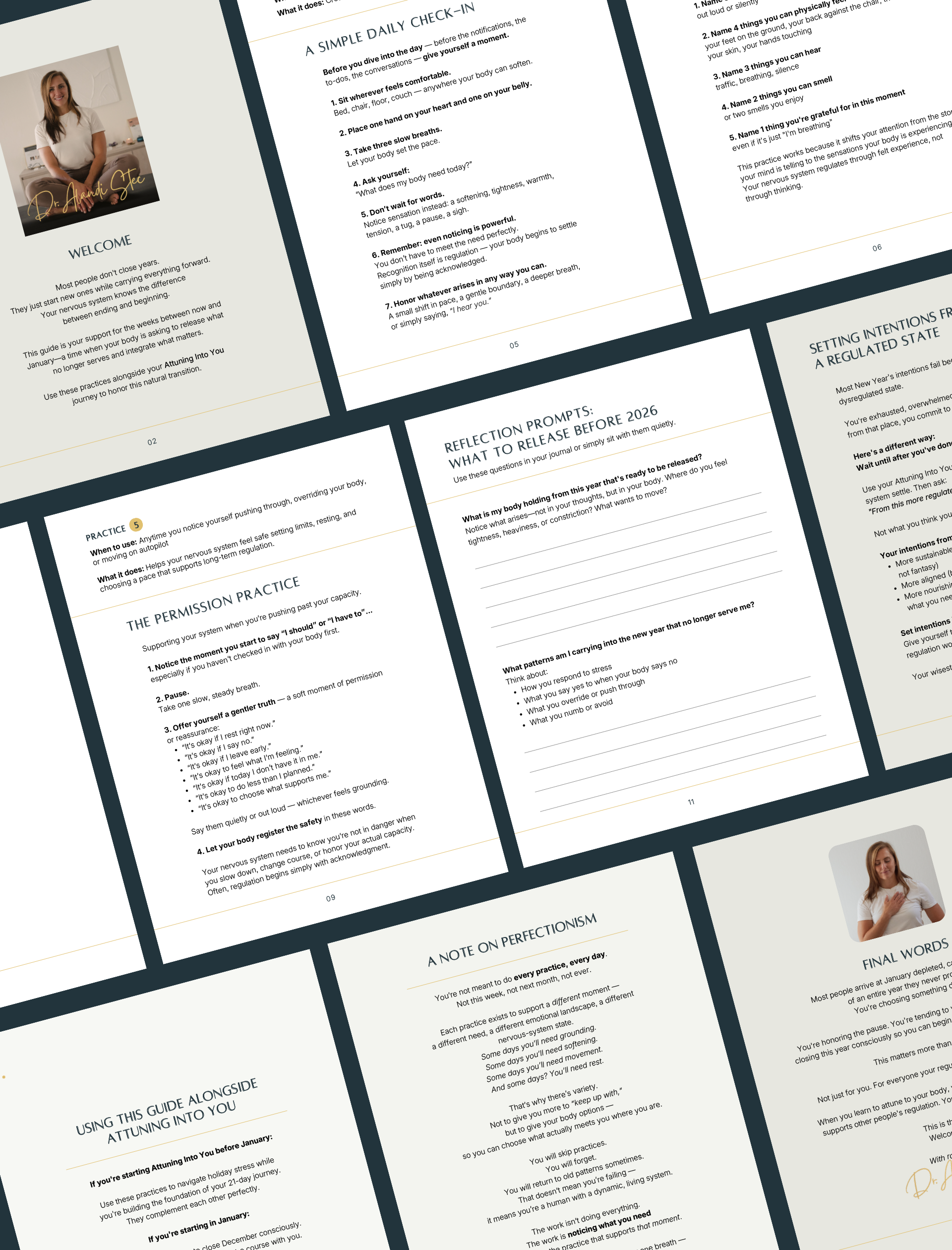
When you commit to 21 days of nervous system work in December, you're not checking off another task before the year ends. You're fundamentally shifting the ground you'll be standing on when January arrives.
Week One: Awareness
Your body begins to recognize what it's been holding. The chronic tension you'd stopped noticing. The shallow breathing you'd normalized. The activation that had become baseline. You're not trying to fix anything yet. You're developing honest awareness of your actual state.
Week Two: Discharge
With daily practices, your nervous system begins to complete stress cycles that have been stuck. The grip in your shoulders releases slightly. Sleep deepens. You have moments of feeling actually settled instead of just managing activation. Your body is remembering what regulation feels like.
Week Three: Integration
New patterns start establishing. You notice you're responding differently to stress. Small challenges don't derail you the way they did two weeks ago. You have more access to choice instead of just reacting. The exhaustion that seemed permanent begins to lift.
By the time you reach the end of December, something fundamental has shifted. Not because all your problems are solved. But because your nervous system has moved from survival mode to a place where sustainable change becomes possible.
This means:
Intentions come from desire, not depletion.
When your system is regulated, you can actually feel what you want. Not what you think you should want. Not what would fix you. What genuinely calls to you. These are the intentions that last because they're rooted in authentic capacity.
You have the resources to follow through.
When your nervous system isn't spending all its energy managing chronic activation, you have bandwidth for new behaviors. The meditation practice you've been wanting doesn't feel like another overwhelming task. It feels possible.
Changes build on solid ground.
Instead of resolutions collapsing under the weight of unprocessed stress, they're supported by a nervous system that has capacity. The foundation holds because you've done the work to stabilize it.
You end the year complete.
Rather than dragging 2025's unmetabolized stress into 2026, you've processed it. The page actually turns instead of just carrying forward the same patterns with a new date.
This is what release before resolve makes possible.
Not perfection. But genuine capacity for the changes you want to make.

Why 21 Days, Why Now
Twenty-one days isn't arbitrary. It's the minimum timeline research shows for establishing new nervous system patterns.
One meditation helps in the moment. One night of good sleep provides temporary restoration. But lasting nervous system change requires consistent, repeated experiences that teach your body a new way of being.
Three weeks of daily practice creates:
• New neural pathways that support regulation
• Body memory of what settled feels like
• Capacity to return to calm after activation
• Resources you can draw on when stress hits
Starting in early December means you complete the program before the final week of the year. You're not trying to do nervous system work while traveling or hosting or managing holiday logistics. You're doing it while there's still space. While you can establish the practice before the season's final intensity.
The daily practices include:
• Guided Yoga Nidra that creates deep rest beyond what sleep can provide
• Breathwork sequences that reset your autonomic nervous system
• Somatic practices that help discharge stored tension
• Meditation that builds regulation capacity over time
• Education about what you're experiencing and why
Twenty minutes to an hour each day, depending on what you need and what you have capacity for. This isn't another obligation adding to your overwhelm. It's the foundation that makes everything else manageable.
By completing release work in December, you arrive at January ready for resolution. Not because you're fixed or perfect. But because you've cleared the ground. Processed what needed processing. Created capacity where there was only depletion.
The intentions you set from that place look completely different. And they actually hold.
What Participants Notice
People who do this work in December report something unexpected: the holidays actually feel different.
Not because the demands disappear. Not because family dynamics magically improve. Not because December suddenly becomes easy.
But because their nervous system has more capacity. More resilience. More ability to be present rather than just surviving.
They notice:
"I'm not dreading family gatherings the way I usually do. I can actually be there without getting completely drained."
"The work stress hasn't changed, but I'm not taking it home in my body the way I was. I can actually transition at the end of the day."
"I'm sleeping better than I have in months. Like my body finally remembered how to settle."
"The last-minute holiday chaos isn't sending me into complete overwhelm. I have space to respond instead of just react."
"I actually feel ready for January. Not from pressure or 'shoulds' but from genuine capacity."
This is what happens when you support your nervous system before trying to change your life. The foundation shifts. And everything you build from there becomes more sustainable.
The Order Matters
You can't skip to resolution and expect it to work. The order is important.
First: Release. Process. Discharge. Metabolize.
Let your body complete what's been stuck.
Clear space by working with what's already there instead of ignoring it.
Then: Resolve. Intend. Plan. Build.
Set goals from a nervous system that has capacity instead of one that's drowning.
This isn't just semantics. It's the difference between change that lasts and resolutions that collapse by February.
Your body knows this. That's why you feel exhausted at the thought of setting more goals. That's why January intentions have started to feel performative. Your nervous system is trying to tell you something needs to happen first.

What Your Body Already Knows
You don't need another pep talk about following through on resolutions. You don't need more discipline or willpower or a better planning system.
You need to give your body what it's been asking for all along. Space to process. Permission to release. Support to metabolize the year that just happened.
This isn't weakness. It's wisdom.
Your nervous system understands something your mind keeps trying to override: you can't build sustainable change on a foundation of chronic depletion. The ground has to shift first.
December is when you're finally ready to hear this. When the exhaustion is visible enough that you can't ignore it anymore. When January looming ahead makes you realize something needs to be different this time.
Your body isn't wrong about what it needs. It needs release work before resolution work. Processing before planning. Space to discharge before capacity to build.
This is your invitation to honor that sequence.
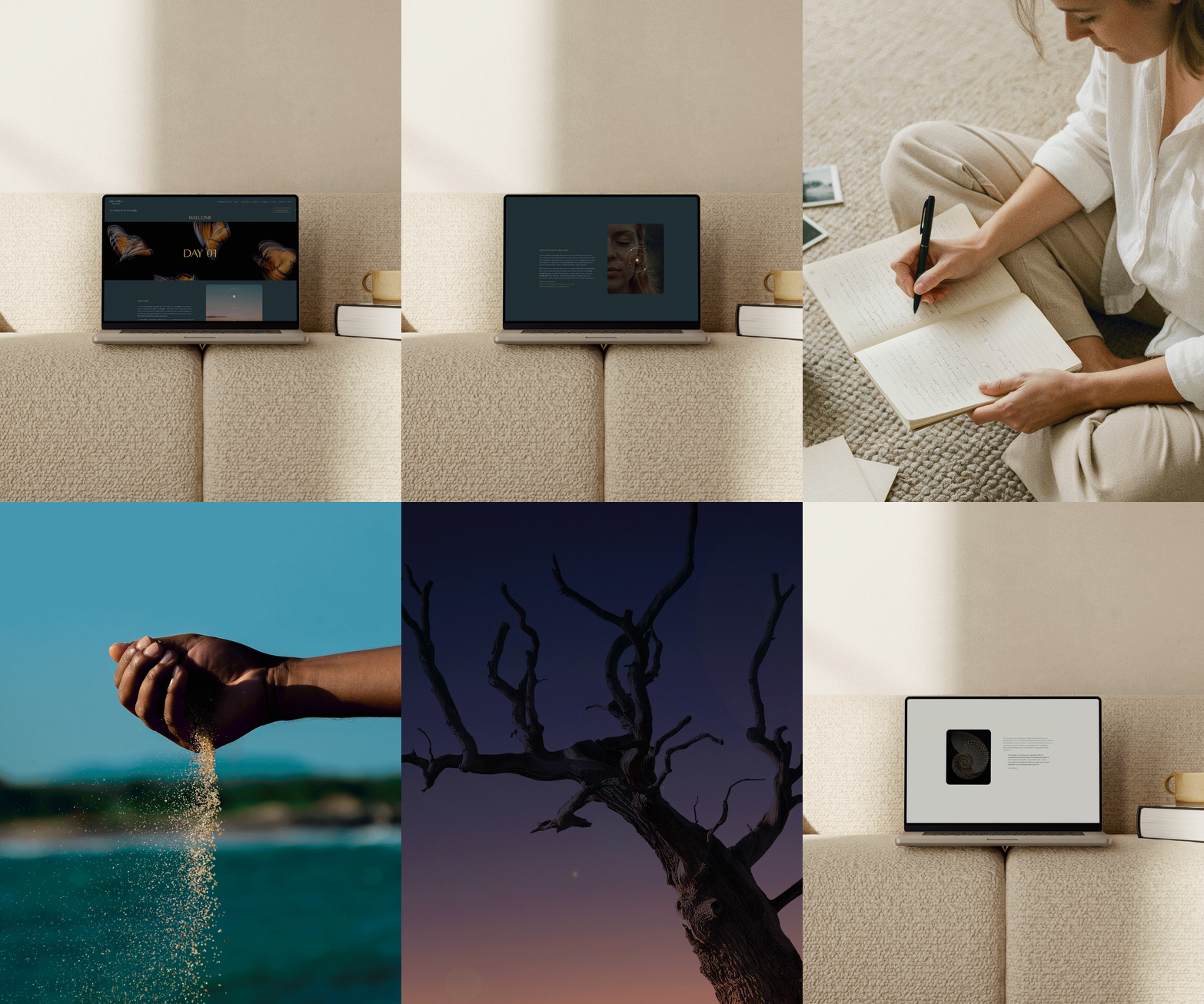
Attuning Into You is 21 days of release work. Daily practices that help your nervous system process what it's been holding. Deep rest that creates genuine restoration. Somatic tools that discharge activation instead of just managing it. Education that helps you understand what you're experiencing.
Do the release work now. Arrive at January ready for resolution.
About Dr. Alandi Stec
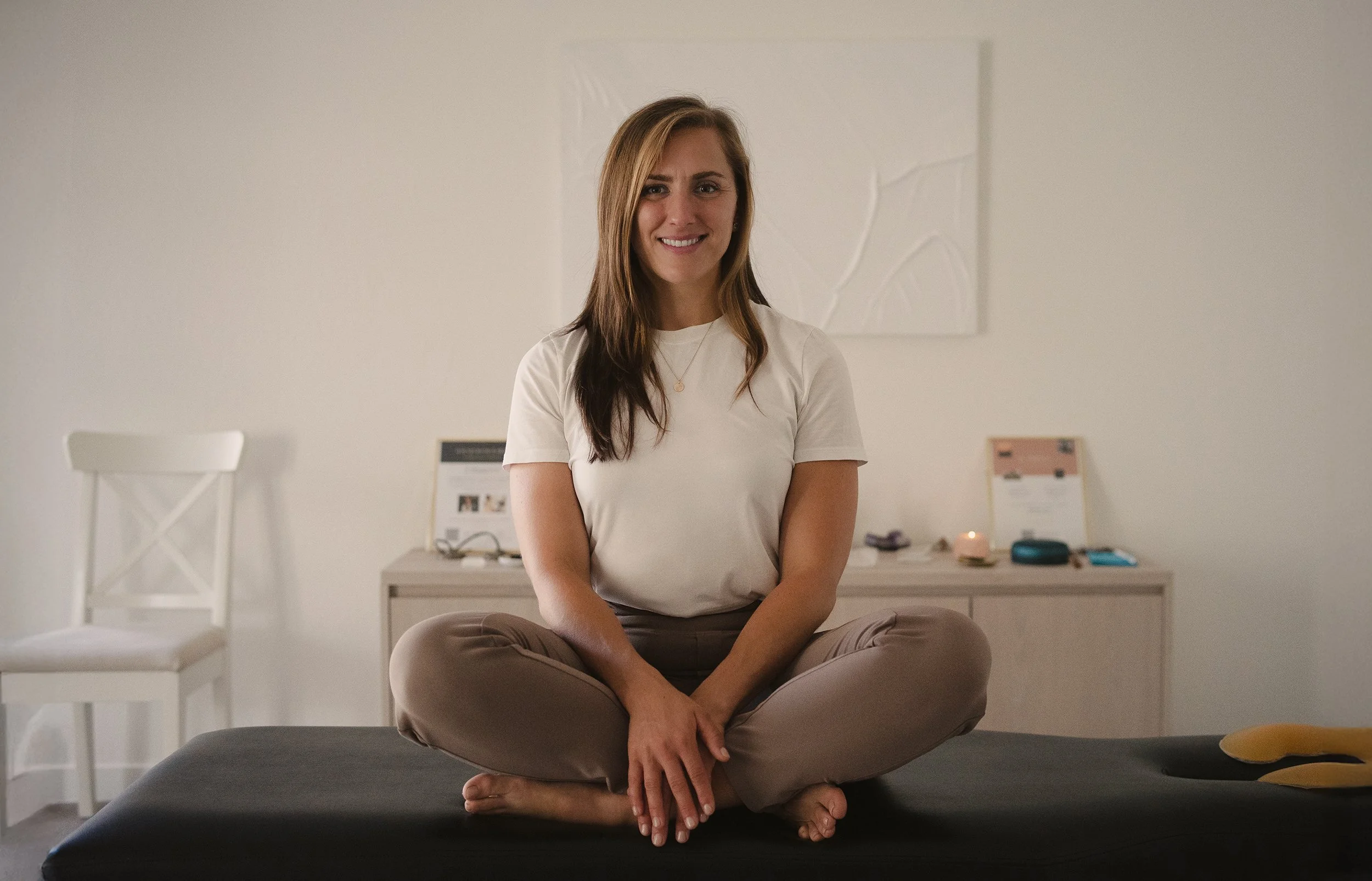
Dr. Alandi Stec is a Doctor of Chiropractic, Reiki Master, and nervous system educator. Through Attuning Into You and other programs, she guides people in building the nervous system resilience that makes sustainable change possible.