
Why Your Shoulders Won't Release - Nervous System Holding.
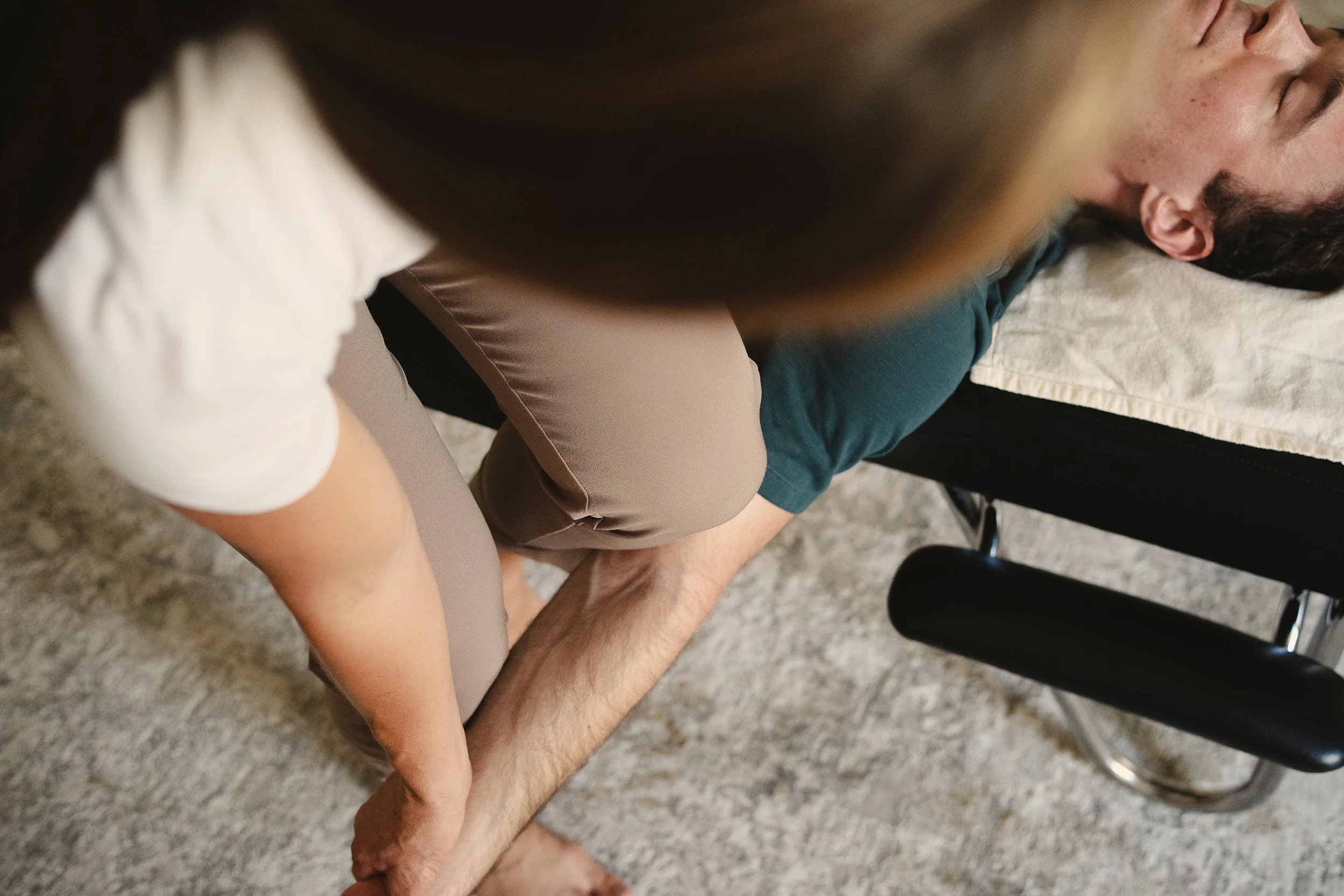
Your shoulders are up by your ears again.
You've caught yourself doing it three times today already. Hunched forward at your desk, breath shallow, muscles locked in a brace you didn't consciously choose.
You roll them back. They drop for a moment. Five minutes later, they're right back up.
This isn't about bad posture. It's about what your body is holding that it hasn't been able to release.
The Tension That Lives in Your Shoulders
You wake up with tight shoulders. You move through your day with tight shoulders. You go to bed with tight shoulders.
Sometimes the tension creeps up your neck and triggers a headache. Sometimes it spreads across your upper back, creating a band of tightness that makes everything feel harder. Sometimes you catch yourself holding your breath because the tension has locked your ribcage.
You've tried stretching. You've rolled on tennis balls. You've booked massages that feel amazing for two days and then the tightness returns, exactly as it was before.
You've adjusted your workspace. Raised your monitor. Bought an ergonomic chair. Set reminders to check your posture. And still, your shoulders climb toward your ears the moment you're not actively thinking about it.
The frustration compounds. You start to feel like this is just who you are now. The person with tight shoulders. The person who carries tension. The person whose body won't let go.
Here's what most people don't realize:
your shoulders aren't tight because you're sitting wrong or sleeping in the wrong position. They're tight because your nervous system is bracing for something. And until your nervous system feels safe enough to release that brace, no amount of stretching will create lasting change.
Your shoulders are speaking the language of your nervous system. And they've been trying to tell you something for a long time.
Why Conventional Approaches Miss the Mark
So you try everything you can think of. You stretch. You strengthen. You correct your posture. And nothing sticks.
Why massage feels good but doesn't last:
A skilled massage therapist can release the muscle tension temporarily. Your shoulders drop. You feel lighter. You can breathe more easily. But within hours or days, the tension returns. Not because the massage wasn't good, but because it addressed the symptom without addressing what created it. Your nervous system is still in a state of activation, and it will recreate the tension pattern as long as that activation remains.
The posture correction trap:
You've been told to sit up straight, pull your shoulders back, engage your core. And when you remember to do it, your posture does improve. But it takes constant effort. The moment your attention drifts, your body collapses back into the familiar pattern. That's because posture isn't just about muscular strength or awareness. It's a reflection of your nervous system state. When your system is activated, your body organizes itself around protection. No amount of conscious correction will override that as long as the underlying activation persists.
Stretching vs. releasing stored activation:
Stretching can provide temporary relief. It can increase range of motion and reduce acute discomfort. But chronic shoulder tension isn't about tight muscles that need lengthening. It's about a nervous system holding pattern that keeps recreating the tightness. You're not lacking flexibility. You're lacking the felt sense of safety that would allow your body to let go.
Why ergonomic fixes help but don't solve it:
Better workspace setup matters. It reduces strain and supports healthier alignment. But if your nervous system is dysregulated, you'll find a way to brace even in the most ergonomically perfect setup. You'll perch on the edge of that expensive chair. You'll hunch over that perfectly positioned keyboard. Because the tension isn't about the environment. It's about your body’s response to the environment.
The real issue isn't that you need better tools or techniques. It's that your body has learned to hold, and it won't stop holding until it feels safe enough to release.
This chronic holding pattern is one of the clearest signs your nervous system needs support. When tension becomes your body's default state, it's communicating something deeper than muscle fatigue.
Your Shoulders as Nervous System Antenna
Your shoulders are uniquely positioned in your body's protective system. They're one of the first places to respond when your nervous system perceives threat.
Watch someone get startled. Their shoulders shoot up toward their ears instantly. It's the startle reflex, hardwired into your nervous system. Shoulders rise to protect the vulnerable neck and head. It happens before conscious thought.
Now imagine that startle response never fully completes. Imagine your nervous system stays slightly activated, constantly scanning for the next threat. Your shoulders stay slightly elevated, muscles slightly contracted, ready to protect.
This is what chronic shoulder tension actually is. It's not one big trauma or one terrible ergonomic setup. It's hundreds or thousands of incomplete stress responses, layered on top of each other, creating a holding pattern your body can't release on its own.
The sympathetic nervous system and shoulder bracing:
When you're in sympathetic activation (the mobilization response that prepares you to fight or flee), certain muscles activate automatically. The trapezius muscles that elevate your shoulders. The muscles along your neck that prepare for quick head movements. The muscles across your upper back that pull your body into a protective forward curve.
These aren't conscious choices. They're automatic responses controlled by your autonomic nervous system. And when your system lives in chronic low-level activation, these muscles stay partially contracted all the time.
How unprocessed stress lives in your upper body:
Your body is designed to process stress through movement and discharge. Animals in the wild shake after a threatening encounter, releasing the activation from their system. Humans often can't complete this cycle. You can't shake or run or yell in the middle of a stressful meeting or difficult conversation. So the activation gets stored. And your shoulders, positioned at the intersection of your core and your head, become a primary storage site.
This is why your shoulders carry not just physical tension, but emotional weight. The stress you couldn't express. The anger you couldn't release. The fear you had to swallow. The overwhelm you had to push through. All of it lives in the muscles and fascia of your upper body.
The vagus nerve connection:
Your vagus nerve, the primary nerve of your parasympathetic (rest and restore) system, runs through your neck. When shoulder and neck tension becomes chronic, it can affect vagal tone. The physical tension creates nervous system feedback. Your body reads the tightness as a signal that you're not safe, which creates more activation, which creates more tension. The loop reinforces itself.
This is why releasing your shoulders isn't just about feeling more comfortable. It's about interrupting a feedback loop that affects your entire regulatory capacity.
Just as jaw tension reflects nervous system dysregulation, shoulder holding patterns reveal where your body stores unprocessed stress. Different symptoms, same underlying mechanism.



The Anatomy of Shoulder Holding Patterns
Let's get specific about what's actually happening in your body when your shoulders won't release.
Forward Head Posture and Nervous System Activation
When your nervous system is activated, your body organizes itself into a protective posture. Head forward, shoulders rounded, chest slightly collapsed. This position protects your vulnerable front body (heart, lungs, digestive organs) while keeping your eyes oriented forward to scan for threat.
The problem is that this position requires constant muscular effort to maintain. Your head weighs 10-12 pounds. When it's balanced directly over your spine, your bones carry the weight. When it shifts forward even a few inches, your muscles have to work constantly to keep it from falling. That load falls primarily on your upper trapezius, levator scapulae, and suboccipital muscles.
These muscles aren't designed for constant contraction. They're designed for movement. But when your nervous system stays activated, they don't get to rest.
Over time, this creates a feedback loop. The forward head position signals to your nervous system that you're in a protective state. Your nervous system responds by maintaining the activation. The activation maintains the forward head position. Round and round.
Breath Restriction and Shoulder Tension Feedback Loop
Your shoulders and your breath are intimately connected. When you breathe fully and deeply, your ribcage expands in all directions. Your shoulders naturally soften and drop with each exhale.
But when your nervous system is activated, your breathing pattern changes. You shift from deep belly breathing to shallow chest breathing. Your diaphragm can't fully descend because your body needs to stay ready for action. So you recruit the accessory breathing muscles in your neck and shoulders to move air in and out.
These muscles, the scalenes and sternocleidomastoid, aren't designed for constant use. When they become your primary breathing muscles, they fatigue and tighten.
And here's where the feedback loop intensifies: shallow breathing signals to your nervous system that you're under threat. Your system responds by increasing activation. The increased activation creates more shallow breathing. The shallow breathing creates more shoulder tension.
You can stretch and massage all day, but if your breathing pattern stays dysregulated, the tension will return.
The Sympathetic/Parasympathetic Balance in Your Upper Body
Your upper body is a primary site of sympathetic nervous system expression. When you're activated, blood flow increases to your arms and shoulders (preparing you to fight or flee). Muscles contract. Fascia tightens. The entire region becomes dense with held energy.
For balance, you need parasympathetic activation. You need your ventral vagal system to come online and signal safety. This allows muscles to soften, fascia to release, blood flow to normalize.
But parasympathetic activation requires certain conditions. A sense of safety. The ability to settle. Time and space for the body to downregulate. When life doesn't provide these conditions, or when your body can't access them even when they're available, sympathetic dominance becomes your default.
Your shoulders bear the weight of this imbalance.
How Desk Work Compounds Nervous System Dysregulation
Sitting at a desk all day isn't just physically constraining. It's neurologically activating.
Humans are designed for varied movement. Walking, reaching, turning, bending. When you sit still for hours, your body reads it as restriction. Your nervous system interprets restriction as potential threat. Threat triggers activation. Activation creates tension.
Add to this the nature of most desk work: constant mental activation, email pressure, deadline stress, cognitive demand without physical discharge. Your nervous system stays elevated, but your body has no outlet for the activation. So it stores the energy in your shoulders and neck.
This is why the tension feels worse at the end of a workday, even though you've barely moved. You're not physically tired. You're holding tension you never got to release.
Emotional Holding Patterns: The Weight You Carry
There's a reason we say someone is "shouldering responsibility" or "carrying the weight of the world." Language reflects somatic truth.
Your shoulders bear not just physical load, but emotional and psychological weight. The expectations you're holding. The responsibilities you've taken on. The burdens you can't put down. The armor you wear to move through the world.
Some people develop what bodyworkers call "armoring" in their shoulders. A thickness, a density, a hardness in the tissue that goes beyond simple muscle tension. This is fascia that has organized itself around chronic holding, creating a protective layer that feels almost solid.
This isn't weakness. It's survival. Your body adapted to the demands placed on it. But now that adaptation has become a cage, and your nervous system can't find its way out alone.
Specific Solutions: Releasing Shoulder Tension Through Nervous System Regulation
So what actually helps? What creates lasting release rather than temporary relief?
The answer is addressing the holding pattern at its source: your nervous system's state.
Nervous System Reset for Shoulders
This isn't a stretching exercise. It's a practice in creating the conditions for your nervous system to release what it's holding.
Find a comfortable position, either seated or lying down.
Let your awareness drop into your shoulders without trying to change anything.
Notice the quality of the holding.
Is it gripping? Dense? Activated? Frozen? Just observe.
Now, with your attention still in your shoulders, take a full breath in.
As you exhale, imagine the tension in your shoulders could make a sound. Let whatever sound wants to emerge come out (a sigh, a groan, a release of air). Don't force it or perform it. Let it be organic.
Repeat this three to five times.
Inhale fully. Exhale with sound, letting your shoulders drop slightly with each exhale.
Then pause and notice.
What's different? Has anything shifted? Can you sense more space?
The sound is important. It gives the tension somewhere to go. It creates a pathway for discharge that bypassing language and thought, connecting directly to your nervous system's release mechanism.
Creating Awareness Without Force
Most people try to force their shoulders down. "Relax your shoulders!" "Drop your shoulders!" This rarely works because you can't override a nervous system holding pattern with willpower.
Instead, practice awareness without agenda.
Set a gentle reminder on your phone three times a day. When it goes off, pause and ask: "Where are my shoulders right now?" Don't try to fix them. Just notice. Are they up by your ears? Rounded forward? Braced?
This simple act of noticing, without judgment or force, begins to create space between the automatic pattern and your conscious awareness. Over time, this space allows for organic release.
Your nervous system responds to curiosity and gentleness. It resists force and pressure.
Breathing Practices That Release Shoulder Tension
Your breath is the most direct tool you have for nervous system regulation. And because breath and shoulder tension are so intimately connected, restoring healthy breathing patterns naturally releases shoulder holding.
Try this throughout your day:
Place one hand on your belly and one hand on your chest. Breathe normally and notice which hand moves more. If it's primarily your chest hand, your breathing is shallow and likely contributing to shoulder tension.
Now, without forcing, see if you can direct your breath lower. Imagine breathing into your belly, your lower ribs, even your back. The movement should spread in all directions, not just up and down.
As your breath deepens and spreads, your shoulders naturally have more space to drop. You're not forcing them down. You're creating the conditions that allow them to release.
Daily Practices for Shoulder Release
Small, consistent practices create more lasting change than occasional intense interventions.
Morning shoulder check-in (2 minutes):
Before you get out of bed, bring awareness to your shoulders. Are they already activated? Can you soften them while still lying down? Take five slow breaths, allowing your shoulders to settle into the mattress with each exhale.
Midday movement break (3 minutes):
Set a reminder for mid-afternoon. Stand up, shake out your arms, roll your shoulders forward and back slowly (not forcing, just moving). Take three deep sighs with sound. This interrupts the accumulation pattern before it becomes locked in.
Evening release practice (5 minutes):
Before bed, lie on your back with your arms at your sides or resting on your belly. Focus on the weight of your shoulders dropping into the surface beneath you. With each exhale, imagine releasing a little more. This signals to your nervous system that the day is complete and it's safe to let go.
These practices work not because they're special techniques, but because they create regular moments of regulation. They give your nervous system repeated experiences of safety and release. Over time, this becomes your new baseline.
What Release Feels Like
Real shoulder release doesn't happen all at once. It unfolds in layers.
First, you might notice moments of softening. You'll be sitting at your desk and suddenly realize your shoulders have dropped without you consciously doing it. These moments are fleeting at first, but they're significant. Your nervous system is practicing a new pattern.
Then you might notice that the tension doesn't return as quickly after it releases. Maybe your shoulders stay soft for an hour instead of five minutes. Maybe you can take a full breath without restriction.
Eventually, you start to feel a fundamental shift in how you inhabit your upper body. There's more space. More ease. More fluidity. Your shoulders can rise when you need them to (reaching up, carrying something) and then release back to neutral. They're responsive rather than fixed.
What changes alongside shoulder release:
Your breath deepens naturally. The tightness across your chest softens. Headaches that originated from neck and shoulder tension decrease in frequency or intensity. You sleep better because your body can actually settle.
You might also notice emotional shifts. Tears that have been held back for months suddenly surface. Anger you didn't know you were carrying finds expression. Grief moves through. This isn't a problem. It's the stored emotion that was locked in the tissue finally finding release.
Your body knows how to let go. It's been waiting for the conditions that make it safe to do so.


When to Seek Support
Sometimes the holding pattern runs too deep for self-practice alone to shift. That's not failure. That's information.
Consider professional support if:
• Your shoulder and neck tension has been present for years
• The tension significantly limits your range of motion or daily activities
• You experience frequent headaches or other symptoms stemming from shoulder tension
• Self-practice provides temporary relief but the pattern quickly returns
• You sense there's structural misalignment contributing to the tension
How Gentle Chiropractic Addresses Shoulder Patterns
Traditional chiropractic often focuses on the spine in isolation. Nervous system-centered chiropractic looks at how structure, nervous system, and holding patterns interact.
When structural restrictions in the spine or craniosacral system contribute to shoulder tension, gentle adjustments can create the space for release. Bio-Geometric Integration, the approach we use at Life Force Chiropractic, works with the body's inherent intelligence. Adjustments support the nervous system's capacity to regulate rather than forcing the structure into position.
Many people find that when structural patterns shift, the nervous system holding patterns soften too. The body no longer needs to brace against misalignment. Energy that was going toward compensation becomes available for healing.
For those in Pleasant Hill and the broader Bay Area (Walnut Creek, Lafayette, Orinda, Concord, Danville), this is the work we do. We address shoulder and neck tension by supporting both the physical structure and the nervous system patterns that maintain the holding.
The care is gentle. It meets your body where it is. And it honors the intelligence your body already has.
How Online Practices Build Daily Capacity
Professional care creates shifts, but daily practice maintains them. This is where online support becomes invaluable.
Attuning Into You offers 21 days of guided practices for nervous system regulation and somatic release. While it's not specifically about shoulder tension, the regulation work naturally affects holding patterns throughout your body.
You'll learn practices for:
• Recognizing where you hold tension before it becomes chronic
• Working with breath to support parasympathetic activation
• Creating moments of discharge throughout your day
• Understanding what your body is communicating through its patterns
• Building capacity for release rather than forcing it
The course is self-paced with lifetime access. You work with the practices as your body is ready, not according to an external timeline.
Frequently Asked Questions
Is my shoulder pain from my nervous system or an actual injury?
Both can be true simultaneously, and they often interact.
If you've experienced a specific injury (car accident, fall, sports injury), there may be structural damage that needs medical attention. See a healthcare provider to rule out serious injury.
However, even with a clear injury, nervous system patterns affect how you heal. Your body might compensate around the injury site, creating tension in surrounding areas. Or the trauma of the injury might create a protective holding pattern that persists long after the tissue has healed.
Conversely, if you have shoulder tension without a clear injury history, nervous system dysregulation is likely the primary factor. The pain is real. The tissue changes are real. But they're the result of chronic holding rather than acute damage.
In either case, addressing nervous system patterns supports healing. Structure and regulation work together.
How long does it take for shoulders to release through nervous system work?
The timeline varies widely based on how long the pattern has been present and how deeply it's embedded.
Some people notice initial softening within days of consistent regulation practice. They sleep better. Their range of motion improves slightly. The tension doesn't return as quickly after release.
Deeper release, the kind where your shoulders can stay soft throughout a stressful day or where you no longer need conscious effort to maintain ease, typically takes weeks to months.
This isn't because the work is slow. It's because your nervous system needs to learn that it's truly safe to let go. That takes repetition and consistency. Each practice builds on the last, creating a new baseline.
What matters more than speed is direction. Are you moving toward more ease, even gradually? That's what we're tracking.
Can chiropractic help with chronic shoulder tension?
When the chiropractic approach addresses nervous system regulation alongside structural alignment, yes.
Gentle adjustments can release structural restrictions that contribute to shoulder tension. Craniosacral work can address restrictions in the upper spine and base of the skull that affect neck and shoulder patterns. The combination creates space for the nervous system to downregulate.
What doesn't work is aggressive manipulation that activates the nervous system further. If your body braces against the adjustment, you're reinforcing the protective holding pattern rather than releasing it.
The key is finding care that works with your nervous system's innate intelligence rather than overriding it. That's what creates lasting change.
What's the difference between muscle tension and nervous system holding?
Muscle tension is the symptom. Nervous system holding is often the cause.
Muscle tension can result from overuse, acute strain, or specific injury. You work out too hard and your shoulders are sore the next day. You carry heavy bags and your traps ache. This is straightforward muscle fatigue and it resolves with rest.
Nervous system holding creates persistent muscle tension without clear physical cause. The muscles stay contracted because the nervous system is signaling them to stay ready. Even when you rest, even when there's no physical demand, the tension remains.
You can massage nervous system holding and it will temporarily release. But the pattern returns because the underlying signal hasn't changed. Your nervous system is still in a state that requires protection.
Addressing nervous system holding means working at the regulatory level, not just the muscular level. That's what creates patterns that shift and stay shifted.
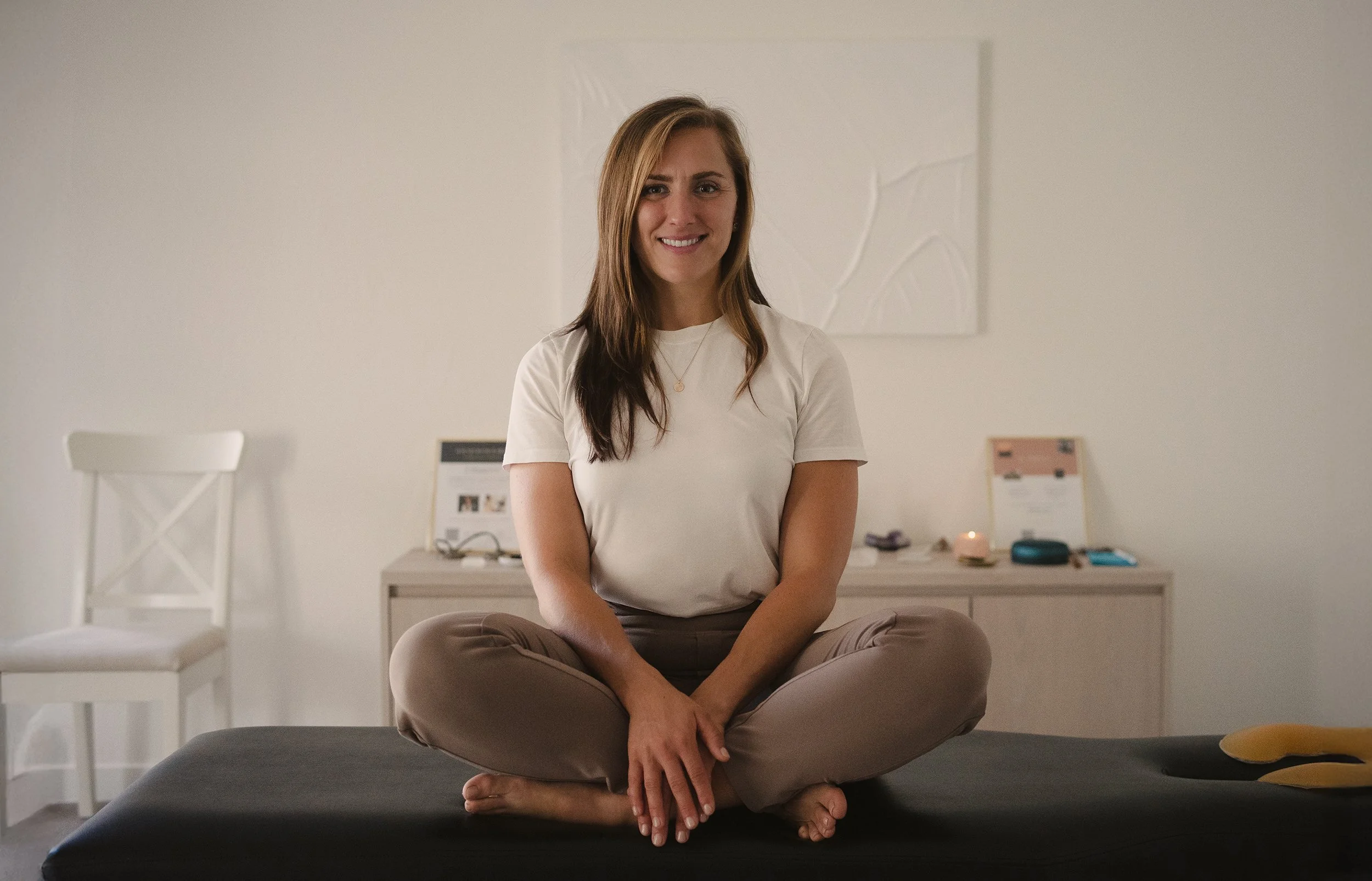
About Dr. Alandi Stec
Dr. Alandi is a Doctor of Chiropractic and Reiki Master practicing nervous system-centered care in Pleasant Hill, California. Her work integrates Bio-Geometric Integration, craniosacral therapy, and somatic practices to support the body's natural capacity for regulation and healing. She works with clients locally in the Bay Area and nationally through online courses focused on nervous system attunement and embodied wellness.

A FREE PRACTICE TO TAKE WITH YOU
Find Your Way Back to Center
A free guided meditation for settling the body and quieting the mind.
This 20-minute guided meditation offers a simple space to slow down, soften your attention, and reconnect with yourself. Return to it whenever life feels full, your mind feels busy, or you simply need a moment to pause.
Recorded by Dr. Alandi Stec and delivered to your inbox when you join the newsletter.