
Chiropractic vs. Massage for Nervous System Reset: What the Research Says

You're in pain. Your shoulders are tight, your back won't stop aching, and nothing you do at home seems to stick.
So you start researching solutions, and you keep coming back to the same question: Should I book a massage or a chiropractic appointment?
The honest answer is that you're not necessarily choosing between two identical treatments with different names. They're doing fundamentally different things. And if you want real, lasting relief—not just a temporary settling of symptoms—understanding that difference changes everything.
This post walks you through exactly how massage and chiropractic care affect your nervous system differently, what the research actually shows, and how to know which one (or both) is right for you.
What Happens When You Choose Massage
Let's start with what happens when you're lying on a massage table. The therapist's hands move through your muscles, warming them, releasing held tension. Your body recognizes the touch as safe. Within minutes, something shifts.
Your nervous system is noticing: This is safe. I can relax.
When your muscles receive this quality of attention, your parasympathetic nervous system—your body's "rest and repair" system—activates. Blood pressure drops. Breath deepens. The constant low-grade bracing that lives in your shoulders softens.
This is the gift of massage: it tells your nervous system through the language of touch that you don't need to be ready for threat anymore.
Massage works primarily on soft tissues: your muscles, fascia, tendons, and ligaments. A skilled massage therapist can identify where you're holding tension and help those tissues release. The effect is immediate. You feel different walking out than when you walked in.
The limitation? Massage doesn't address what's underneath the muscle tension.
Where Massage Falls Short
Here's the pattern most people experience: You get a massage. You feel great for two or three days. Then the tension creeps back. Your shoulders climb toward your ears again. Your neck gets stiff. You book another massage.
This happens because massage is treating the symptom—the tight muscle—but not the pattern driving the muscle to tighten in the first place.
Let's say your nervous system is running in a subtle but chronic "on guard" state. That signal travels from your brainstem down your spine to your muscles, literally telling them: Stay braced. Stay ready. The muscles obey. They tighten.
A massage therapist can release that tension beautifully. But five days later, that same nervous system signal is still running. And those muscles are still listening. So they brace again.
It's not that massage isn't working. It's that massage is asking your muscles to relax while the deeper pattern—the nervous system holding—is still in place.
This is why so many people say massage helps, but the relief "never lasts." It's not the massage's fault. It's that the foundation hasn't shifted.
The Chiropractic Approach: Why the Spine Matters
Now shift to what happens during a chiropractic adjustment.
A chiropractor is looking at your spine. Not just as a structure (though it is that), but as a highway for nervous system communication. Your spine houses your central nervous system. Every vertebra that's restricted, misaligned, or not moving properly interferes with the signals traveling from your brain to your body.
When a vertebra loses its proper alignment or motion—what chiropractors call a subluxation—that segment can't send clear signals. Your nervous system gets partial information. It responds the way any nervous system responds to partial, unclear information: it goes into protection mode. Something's not right. I need to brace.
A chiropractic adjustment restores alignment and motion to that vertebra. Immediately, the nerve pathway opens. The signal from your brain to your body becomes clear again. Your nervous system receives accurate information: All is well.
When your nervous system gets clear input, it can stop the protective bracing pattern. Your muscles relax—not because someone's hands are on them, but because the signal telling them to tighten has shifted.
This is the difference. Massage says: relax. Chiropractic care says: your nervous system doesn't need to brace anymore.
The Nervous System Mechanism: Why This Matters
To understand this deeper, it helps to know how your nervous system actually regulates itself.
Your autonomic nervous system has two primary branches: sympathetic (your accelerator, your protective fight-or-flight system) and parasympathetic (your brake, your rest-and-repair system). When you're chronically stressed, your sympathetic nervous system stays slightly activated. It's not a full panic response—it's quieter than that. But it's steady.
Your muscles, living downstream of that signal, respond by bracing. Not dramatically. Just... held. Ready.
Massage activates your parasympathetic branch through the direct sensory input of safe touch. It's saying: Brake pedal. Rest mode.
Chiropractic adjustments work differently. By restoring proper spine alignment and nerve flow, they're removing the interference in your nervous system's communication with itself. Instead of your brain sending conflicting or partial signals, it sends clear ones. Your nervous system can then regulate itself more easily, settling naturally into a more balanced state.
Here's what research suggests happens: After a chiropractic adjustment, activity in the prefrontal cortex—the brain's decision-making and calm-control center—increases. Your brain literally has clearer input to work with. It can make better decisions about whether you actually need to stay in protection mode.
Neither approach is "wrong." They're working on different entry points into the nervous system. Massage enters through sensation and touch. Chiropractic enters through structural alignment and nerve flow.
The Real-World Difference: How Long Does It Last?
This is where the practical difference becomes obvious.
After a single massage, most people feel relief for a few hours to a few days. The muscles are relaxed. The nervous system has tasted rest. But unless the underlying pattern (the spinal restriction, the holding pattern) shifts, that relief is temporary. Your nervous system, getting no new information, goes back into its familiar bracing pattern. The muscles follow.
After a chiropractic adjustment, the pattern is different. Your first adjustment might provide relief that lasts a few hours to a few days—similar to massage. But here's what changes: Your body learns. After your second adjustment, relief might last longer because your nervous system and muscles have experienced what "unbraced" feels like. Your body is beginning to remember that state.
By your third or fourth adjustment, relief often lasts longer. What started as a few hours becomes a few days, then a week. Your nervous system is receiving consistent, clear signals. It's reorganizing around a new, less defensive baseline.
This is the advantage of chiropractic care: it builds on itself. The nervous system doesn't just get temporary relief. It gets consistent information that allows it to rewire, to remember what regulation actually feels like.
Most people who commit to a 4-6 week course of chiropractic care report that relief lasts longer and longer. Some eventually reach a place where they maintain improvement with just occasional tune-ups—because their nervous system has genuinely shifted.
When They Work Together (And They Do)
Here's something important: this isn't an either/or choice.
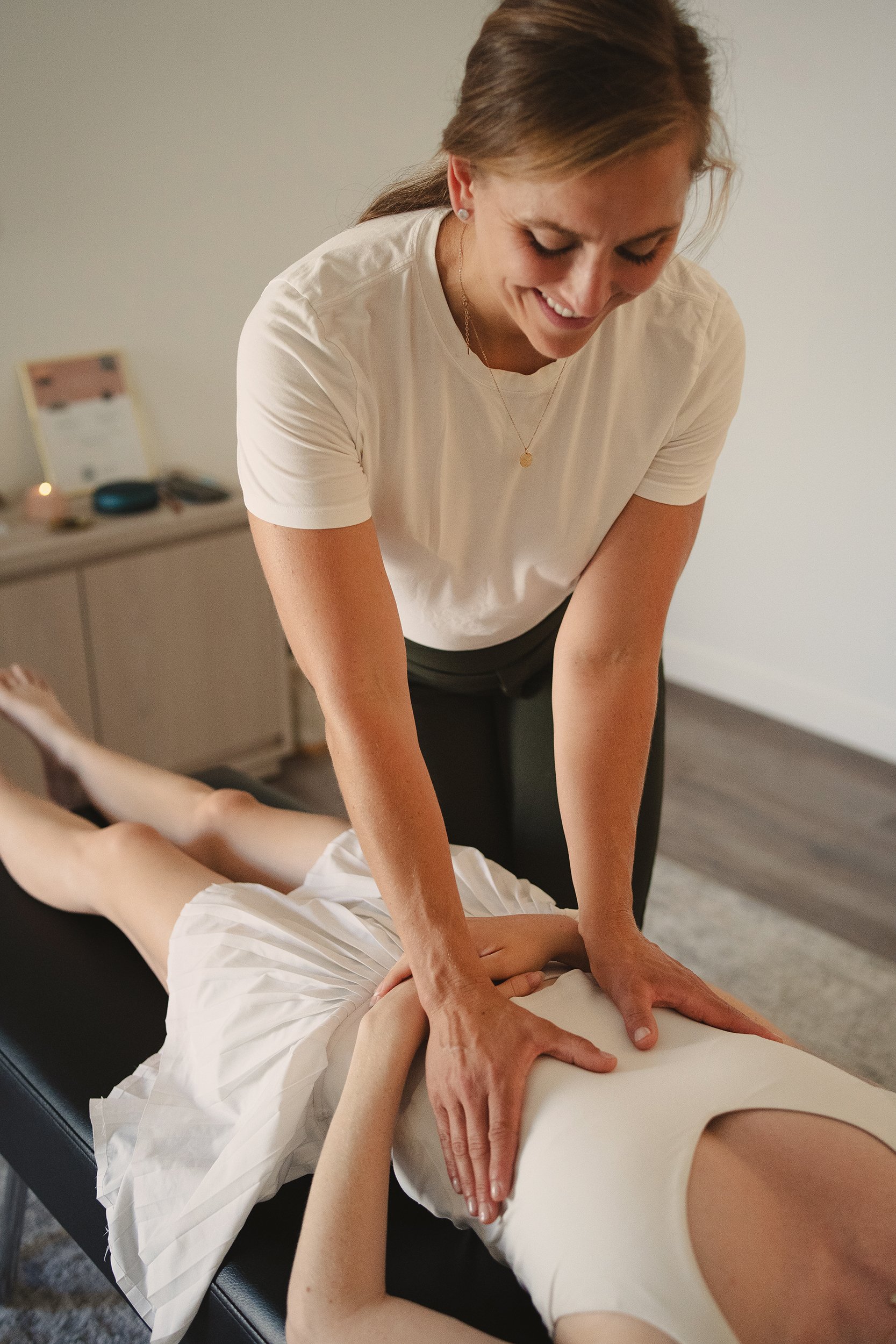
Many of the most successful nervous system regulation protocols use both. Here's why: If your spine has restrictions and your muscles are braced, massage can help relax the muscles enough that your chiropractor can more easily restore alignment. Tight muscles sometimes literally prevent vertebrae from moving into proper position. A good massage first gives your body permission to relax, making the adjustment more effective.
On the flip side, after a chiropractic adjustment, your muscles have sometimes been holding their braced position for so long that they don't immediately know how to release, even though the nervous system signal has changed. A massage after your adjustment helps those muscles actually let go. It also encourages your body to hold that new alignment longer, because the supporting muscles are relaxed instead of pulling against the adjustment.
The research backs this up. Studies suggest that patients who receive both massage and chiropractic care see faster, longer-lasting relief than those who choose either treatment alone.
In the context of nervous system regulation specifically, it works like this:
Massage says: It's safe to relax. Chiropractic says: You don't need to brace anymore.
When both are true, your nervous system has permission and input to settle more deeply.

What You Should Actually Choose
If you're standing in the crossroads, here's how to think about it:
Choose massage as your primary treatment if:
• Your main experience is general muscle tension and you respond well to hands-on relaxation
• You're looking for stress relief and immediate comfort
• You're pregnant, very elderly, or have conditions where spinal manipulation isn't appropriate
• Your pain is acute (recent injury) rather than chronic (years of holding patterns)
Choose chiropractic care as your primary treatment if:
• You have restricted range of motion (can't turn your head easily, bending forward is limited)
• Imaging or a healthcare provider has identified spinal misalignment or nerve pressure
• You've tried stretching, massage, heat, and nothing lasts
• You want lasting change, not just temporary relief
Choose both if:
• You have chronic tension that hasn't responded to either alone
• You want the fastest path to nervous system reset
• You're committed to addressing both the soft tissue patterns and the structural foundation
Dr. Alandi's approach in Pleasant Hill and San Francisco integrates this understanding.
Rather than seeing nervous system regulation as either/or, she works with the whole system: the spinal alignment, the nervous system signaling, the muscle patterns, and even the energetic holding (through craniosacral work and gentle touch).
Sessions are longer than typical chiropractic appointments because the nervous system needs time to actually settle, not just receive an adjustment. It needs to feel heard, respected, and safe. That's where the depth of relief comes from.
The Nervous System Doesn't Think in Either/Or
Here's what's worth knowing: Your nervous system isn't asking you to choose between two separate systems. It's a unified whole.
When you receive care that addresses spinal alignment, soft tissue tension, energetic holding, and nervous system regulation all together, your body has a completely different experience than when you address any single aspect.
The relief isn't temporary because the whole pattern is shifting, not just one layer of it.
Some people start with massage and later add chiropractic care. Some start with chiropractic and find massage accelerates their progress. Some do both from the beginning. There's no single right answer—only the right answer for your body, your history, and what your nervous system most needs to hear right now.
When to Seek Professional Support
If you're experiencing chronic pain, restricted movement, or nervous system dysregulation that hasn't improved with home care, that's the moment to get professional assessment.
A chiropractor can assess whether spinal restrictions are contributing to your pattern. A massage therapist can help you understand where your body is holding tension. Ideally, both can listen to what your system is trying to tell you through its symptoms.
Gentle, nervous-system-centered care—the kind that respects your body's intelligence rather than forcing it—tends to produce more lasting change. Your body isn't trying to be difficult. It's trying to protect you. Care that acknowledges that protection and helps your nervous system feel safe to release it works with your system, not against it.
Ready to Find Your Path to Nervous System Reset
Whether you're leaning toward massage, chiropractic care, or both, the most important thing is beginning. Your nervous system knows what it needs. The right care is the care that helps you listen to it.
If you're in Pleasant Hill, Walnut Creek, Lafayette, or nearby in the East Bay, you're welcome to explore in-person chiropractic care with Dr. Alandi. She works with the whole nervous system—spinal alignment, craniosacral flow, tissue tone, and the subtle energetic holding that creates patterns.
If you're not local or want to begin with self-care practices, the 12-Day Nervous System Regulation course includes gentle somatic exercises designed to help your nervous system settle into a more regulated baseline. Many people find this combination—online practices plus periodic chiropractic support—creates the most sustainable shift.
Either way, you don't have to stay in the pattern you're in. Nervous system regulation is absolutely possible. It just requires care that addresses what's actually driving your symptoms, not just the surface of them.
Frequently Asked Questions
Q: Should I get a massage or chiropractic adjustment?
A: Both have different impacts on your nervous system. Massage helps activate your parasympathetic nervous system (rest and repair mode) by working with soft tissues. Chiropractic care addresses spinal alignment and regulates the autonomic nervous system at a deeper level, helping calm your body's stress response. The choice depends on whether you need muscle relaxation or structural alignment—or both.
Q: Can massage and chiropractic work together?
A: Yes. In fact, they complement each other very well. A massage before chiropractic care can relax tight muscles, preparing your body for adjustment. A massage after chiropractic care helps your muscles release further, encouraging your body to hold the correction longer. Many patients find combining both produces faster, longer-lasting relief than either alone.
Q: How long does relief from a chiropractic adjustment last?
A: Relief can last from a few hours to several days after your first adjustment, depending on your condition's severity. However, after your first few sessions, your body learns to hold the correction longer—what starts as relief lasting a few hours may extend to a week, then two weeks, then longer. This is why establishing a consistent care plan helps build lasting nervous system regulation.
Q: How long does massage relief last?
A: Massage typically provides immediate relaxation and soft tissue relief during and shortly after your session. Relief usually lasts from a few hours to a few days, depending on your muscle tension patterns and how often you receive massage. Regular sessions help accumulate benefits over time, similar to how chiropractic care builds on itself.
Q: Which approach helps with a pinched nerve or structural issue?
A: If your pain stems from a pinched nerve, misaligned vertebrae, or a structural issue visible on imaging, chiropractic care is the better starting point. Chiropractic adjustments directly address spinal alignment and nerve pressure. Massage alone won't correct structural misalignment, though it's an excellent complement to chiropractic care once the structural issue is being addressed.
Q: Is one treatment better for nervous system regulation?
A: Both work on your nervous system, but differently. Massage activates your parasympathetic nervous system (the brake pedal) through muscle relaxation and improved circulation. Chiropractic care regulates your autonomic nervous system by correcting spinal alignment, which restores proper nerve flow from your brain to your body. For lasting nervous system regulation, addressing both the soft tissue patterns and the structural foundation often produces the most sustainable results.

About Dr. Alandi Stec
Dr. Alandi Stec is a Doctor of Chiropractic and Reiki Master specializing in nervous system-centered healing approaches. She serves the Pleasant Hill and Bay Area athletic community through Life Force Chiropractic, combining Bio-Geometric Integration with craniosacral work and somatic practices to support athletes in discovering their body's innate capacity for optimal performance and resilience.